
MINI Cooper Electrical Diagnosis in Tampa
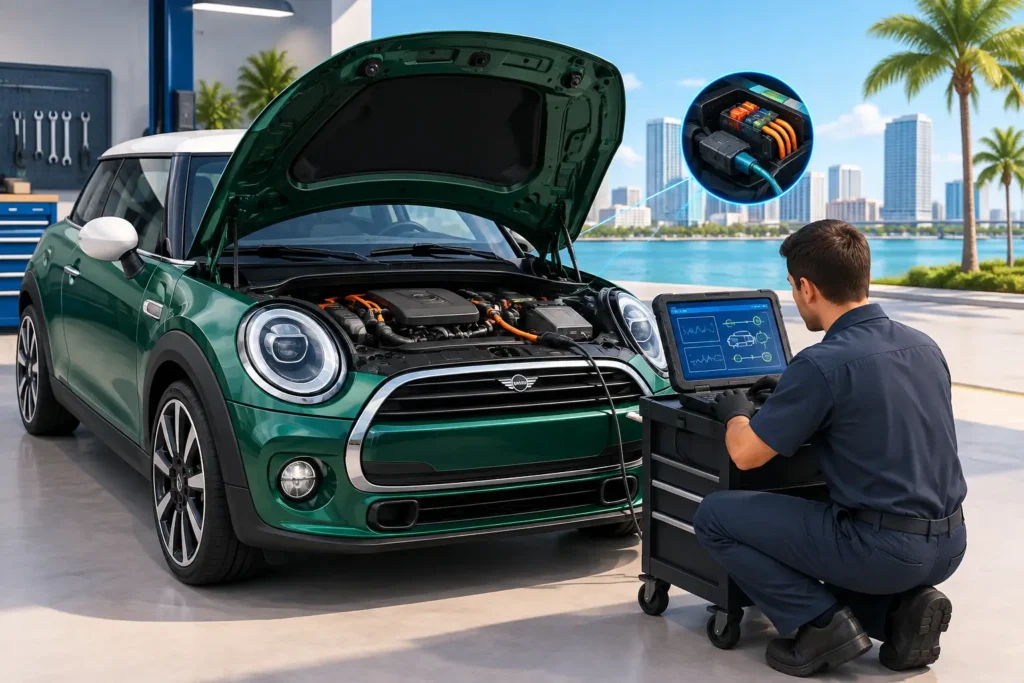
A MINI that suddenly will not start, flashes multiple warning lights, or drains its battery overnight is not a vehicle to diagnose by swapping parts. MINI Cooper electrical diagnosis starts with finding the cause behind the symptom, whether that is a weak battery, a damaged wiring connection, a communication fault, or a module that needs programming.
Modern MINIs pack a surprising amount of technology into a small vehicle. Comfort systems, engine controls, charging management, safety features, infotainment, and driver-assistance equipment all rely on modules that must communicate correctly. A fault in one area can create warnings in another, which is why a proper test matters before approving a repair.
Why MINI Electrical Problems Need a Methodical Diagnosis
A check-engine light or battery warning does not automatically identify the failed part. Fault codes are valuable clues, but they do not tell the full story on their own. A code for low voltage, for example, may be caused by an aging battery, a charging-system issue, a poor ground, excess key-off draw, or a module that is staying awake after the vehicle is parked.
The same principle applies to warning lights for ABS, airbags, steering, drivetrain, or stability control. A damaged wheel-speed sensor may be the problem, but so could a corroded connector, wiring damage near the wheel, or a voltage issue affecting several control units at once. Replacing the first component named by a generic scan tool can turn a simple repair into an expensive guessing game.
MINI vehicles also require the correct battery type and, on many models, battery registration after replacement. Installing a battery without registering it can cause the vehicle's energy-management system to charge it incorrectly. That may shorten battery life and leave the owner thinking the new battery has failed.
Common Signs You Need MINI Cooper Electrical Diagnosis
Electrical problems do not always arrive as a complete no-start. Often, the signs are intermittent: the car behaves normally for days, then produces a warning or refuses to operate one feature. Those patterns are worth documenting because they help narrow the testing process.
Common reasons Tampa Bay MINI owners schedule electrical testing include repeated dead batteries, slow or no cranking, warning messages that come and go, flickering lights, inoperative windows or door locks, radio or screen issues, malfunctioning parking sensors, and cooling fans that continue running after shutoff. Other concerns include a key that is not recognized, a sunroof that stops moving, random dash warnings, or water intrusion after heavy rain.
Heat and humidity can make marginal electrical connections more noticeable. Battery performance can suffer in Florida's climate, while moisture can contribute to corrosion at connectors, grounds, fuse panels, and wiring junctions. In a vehicle with a history of water intrusion, a careful inspection is just as important as electronic scanning.
What a Proper Electrical Diagnosis Includes
The best diagnostic process matches the test to the complaint. If a MINI arrives with a no-start condition, the technician should not begin by assuming the starter is bad. The process begins with the vehicle's history: when the issue occurs, whether warning lights appeared first, whether the battery was recently replaced, and whether repairs or accessories were installed recently.
Full-System Scan and Fault-Code Review
A brand-specific scan tool communicates with modules that a basic code reader may not access. This can include the engine control unit, transmission module, body electronics, ABS, airbag system, battery management, climate controls, and infotainment components.
The technician reviews stored, pending, and shadow fault codes, then looks at the conditions recorded when a fault occurred. Voltage readings, communication errors, mileage, temperature, and fault frequency can help distinguish an active failure from an old code that no longer matters.
Battery, Charging, and Starting-System Tests
A battery can have enough voltage to turn on interior lights and still fail under the load required to start the engine. Proper testing checks battery state of health, resting voltage, voltage drop during cranking, alternator output, belt condition where applicable, and battery-cable connections.
For a recurring dead battery, the key question is whether the vehicle is charging correctly or drawing power while parked. Parasitic-draw testing requires time and patience. The vehicle must enter sleep mode, then current draw is measured and circuits are isolated as needed. Opening a door or waking a module at the wrong time can change the test result, so this is not a quick guess from the service counter.
Wiring, Grounds, and Connector Inspection
Electrical current needs a clean path. Loose terminals, damaged insulation, rodent-chewed wiring, corroded grounds, and moisture in connectors can all cause intermittent faults. Technicians use voltage-drop tests, circuit testing, and visual inspection to locate resistance that may not be visible from the outside.
This step is especially useful after collision repairs, cooling-system leaks, battery replacement, aftermarket accessory installation, or water intrusion. The component may be healthy, but the circuit serving it may not be.
Module Communication and Programming Checks
Many MINI components are controlled by modules that share information across the vehicle network. If one module loses communication, it can trigger multiple warnings and disable features that appear unrelated. The repair may involve restoring power or ground to a module, repairing network wiring, replacing a failed unit, or programming and coding a replacement module to the vehicle.
Programming is not a detail to skip. Certain modules must be configured so the MINI recognizes the new component and all systems work together as intended. Used parts can sometimes seem less expensive, but compatibility, vehicle-specific coding, and hidden internal faults can make them a poor value depending on the module.
Why Generic Repairs Can Cost More
It is understandable to start with the most obvious possibility. A MINI with a dead battery may need a battery. But if it has already received one battery and the issue returns, continuing to replace batteries is not a diagnosis. The same goes for alternators, sensors, switches, and control modules.
Generic repair shops may have capable technicians, but MINI-specific systems reward specialized equipment and familiarity with common failure patterns. A shop that understands the vehicle can separate a low-voltage cascade of warning lights from a genuine multi-module problem. That means fewer unnecessary parts, a clearer estimate, and a better chance of fixing the concern correctly the first time.
At Fox Motors Bimmer Specialists, the goal is to explain what testing found, what repair is needed now, and what can reasonably wait. That gives MINI owners the information to make a confident decision without being pushed into a parts list they do not need.
What You Can Do Before Your Appointment
A little information can make an intermittent electrical concern easier to reproduce. Take a photo of dashboard warnings before they disappear, note whether the issue occurs after rain or after the vehicle sits overnight, and record any recent battery, tire, body, audio, or accessory work. If the MINI has trouble starting, avoid repeatedly attempting to crank it until the battery is fully discharged.
Do not ignore a burning odor, hot battery area, visible smoke, severely dim lights, or a warning tied to brakes, airbags, or steering. Those conditions deserve immediate attention. If the vehicle is unsafe to drive, have it transported rather than risking a breakdown or further damage.
For less urgent concerns, scheduling diagnostic time is the practical first step. Accurate electrical testing can take longer than replacing a visible mechanical part because the fault may need to be verified under specific conditions. That investment usually protects the owner from paying for the wrong repair.
Your MINI should be enjoyable to drive, not a source of uncertainty every time a warning light appears. Bring the symptoms, the vehicle history, and any photos of the messages you have seen. A clear diagnosis turns an electrical mystery into a repair plan that keeps you moving.