
BMW Plug In Hybrid Repair for Tampa Drivers
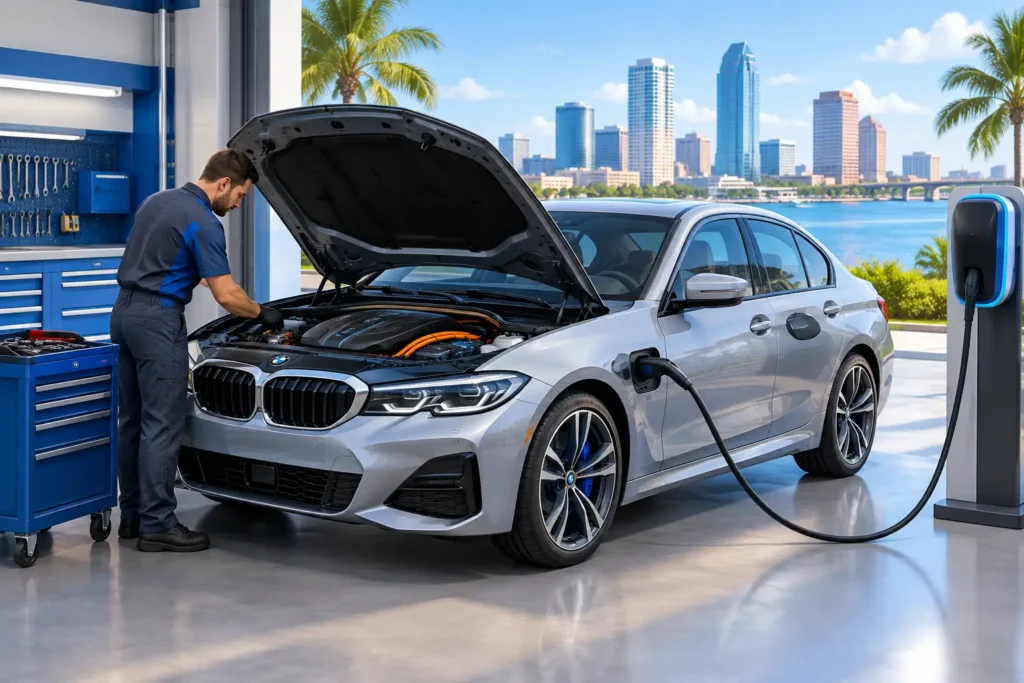
A BMW that will not charge, displays a drivetrain warning, or suddenly runs the engine more than usual needs more than a quick code scan. BMW plug in hybrid repair involves two systems working together: the familiar BMW engine, transmission, brakes, and suspension, plus a high-voltage battery, electric motor, charging hardware, cooling circuits, and control modules. The symptom may feel simple. The cause often is not.
For Tampa drivers, heat, stop-and-go traffic, and daily air-conditioning use can put extra demands on hybrid cooling and electrical systems. Accurate diagnosis protects your time and helps avoid replacing an expensive part that was never the real problem.
What Makes BMW Plug In Hybrid Repair Different?
A plug-in hybrid BMW is not simply a gasoline BMW with a battery added to the trunk. Its powertrain constantly decides when to use electric power, gasoline power, or both. That decision depends on battery state of charge, battery temperature, driving conditions, selected drive mode, software inputs, and information from dozens of sensors and control units.
That complexity is why generic repair-shop guesswork can become costly. A fault message related to the high-voltage system might be caused by a battery issue, but it could also point to a charging-port concern, coolant-flow problem, wiring fault, low-voltage 12-volt battery, communication issue between modules, or software calibration need.
The repair process must begin with BMW-capable diagnostic equipment and a technician who understands how the vehicle is designed to operate. Reading a code is only the first step. Confirming the fault, checking related systems, reviewing live data, and following BMW test procedures are what lead to a correct-first-time repair.
Signs Your BMW Hybrid Needs Attention
Some concerns are obvious, such as a no-start condition or a warning that charging is unavailable. Others are easy to dismiss because the vehicle may still drive normally. Pay attention if you notice reduced electric range, inconsistent charging, an engine that runs when you expect electric operation, unusual fan noise after driving, reduced power, or a check engine or drivetrain malfunction message.
A burning smell, fluid leak, damaged underbody panel, or impact near the battery area deserves prompt professional attention. Do not attempt to inspect orange high-voltage cables, battery connections, or charging components yourself. Orange cabling identifies high-voltage circuits and requires proper safety procedures, protective equipment, and isolation steps.
It is also worth mentioning a change in charging behavior even if no warning light appears. If your BMW used to complete charging overnight and now stops early, charges intermittently, or rejects a charger that previously worked, the vehicle should be tested along with the charging equipment and cable being used.
The 12-Volt Battery Can Cause Big Hybrid Problems
Many owners are surprised to learn that a weak conventional 12-volt battery can trigger confusing messages in a plug-in hybrid. The 12-volt system wakes up control modules and supports the vehicle's electronics. When voltage drops, modules can communicate poorly, store misleading fault codes, or prevent certain hybrid functions from operating.
That does not mean every warning is solved with a 12-volt battery. It does mean a proper diagnostic process checks basic electrical health before condemning high-value hybrid components. On a modern BMW, the battery may also need correct registration and programming after replacement so the vehicle can manage charging properly.
Common BMW Plug-In Hybrid Repairs
The exact repair depends on the model and fault. BMW plug-in hybrid models such as the 330e, 530e, X3 xDrive30e, X5 xDrive45e or 50e, and newer electrified models share core hybrid principles, but their layouts, components, and software can differ significantly.
Charging-system repairs may involve the charge port, charge-door actuator, onboard charging electronics, cable connections, or related control modules. Cooling repairs can involve electric coolant pumps, valves, hoses, radiators, fans, or leaks affecting the battery and power electronics thermal-management system. Because temperature directly affects battery performance and charging, a cooling concern should not be treated as a minor inconvenience.
Other repairs may involve high-voltage insulation monitoring, electric drive components, engine-side faults that affect hybrid operation, or module programming. Software updates and programming are not cosmetic add-ons. In some cases, they are an essential part of completing a repair, restoring communication, or applying a manufacturer-directed correction.
High-voltage battery repair is especially case-specific. A stored battery-related code does not automatically mean the complete battery must be replaced. Technicians need to verify battery condition, cell data when applicable, electrical isolation, temperature readings, cooling performance, and the fault's history. Coverage may also apply under an applicable BMW warranty or emissions-related warranty, depending on the vehicle, mileage, location, and issue. Verify coverage by VIN before authorizing major work.
What a Proper Diagnostic Visit Should Include
A dependable shop should give you a clear explanation of what is known, what needs testing, and what the next step costs before moving forward. That matters with hybrid repairs because symptoms can overlap. A drivetrain warning may be tied to the combustion engine, the hybrid system, or both.
The diagnostic process typically starts with a full vehicle scan and a review of stored faults, freeze-frame information, service history, and warning messages. The technician then verifies the complaint rather than relying only on a code description. This may include checking the 12-volt system, inspecting charging components, testing cooling-system operation, reviewing high-voltage status data, and performing guided test plans with BMW-specific equipment.
If programming is needed, voltage support and stable communication are critical. Interrupting a programming event can create additional module problems, which is one reason this work belongs with a BMW-focused facility that has the right equipment and procedures.
At Fox Motors Bimmer Specialists, the goal is to explain the finding in plain language, provide a transparent estimate, and repair the issue without sending you through a dealership-style maze. Genuine OEM-oriented parts, brand-specific diagnostics, and careful module programming help protect the performance and reliability you bought the BMW for.
How Tampa Heat Affects Plug-In Hybrid Ownership
Florida heat does not automatically damage a BMW hybrid battery, but it makes thermal management more important. Battery systems are engineered with cooling strategies, yet they work harder when a vehicle sits outside, is driven in heavy traffic, or is charged after a hot commute. Air conditioning also adds electrical demand, which can affect displayed electric range.
Range naturally changes with temperature, speed, tire pressure, driving style, and climate-control use. A modest change in range is not always a repair issue. A sudden, sustained drop paired with warnings, reduced power, repeated cooling-fan operation, or charge failures should be diagnosed.
Keeping cooling systems maintained, addressing leaks promptly, and using the correct coolant specification all matter. So does regular inspection of tires and alignment. Low tire pressure or poor alignment will not create a high-voltage fault, but they can reduce efficiency and make an otherwise healthy hybrid seem to be underperforming.
Smart Steps Before You Schedule Service
Bring useful details. A photo of the warning message, the charge level when the issue occurred, the type of charger used, and whether the concern happens only after the vehicle sits can save diagnostic time. If a warning appeared after a pothole strike, curb impact, water intrusion, or body repair, mention that too.
Avoid clearing codes before the appointment if the vehicle is safe to drive. Fault data and conditions present when the warning occurred can be valuable clues. If the vehicle says not to drive, has visible damage near the battery area, smells hot or electrical, or will not shift normally, arrange appropriate transport instead of trying to get it to the shop under its own power.
Plug-in hybrid ownership should feel practical, not uncertain. When your BMW starts sending mixed signals, the best next move is a focused diagnosis from people who know the vehicle's mechanical, electrical, and high-voltage systems. Clear answers early can protect your schedule, your budget, and the miles ahead.